Start With the Area, Not the Product
Nobody starts this project knowing they want 7/8 inch limestone. They know they want a bed by the front step that stops growing weeds and looks better than the bark that is there now.
So this guide is arranged by what you are building. Find your project, and the shortlist is two or three products rather than the whole category.
A Clean, High-Contrast Bed
You want dark rock, and the planting to pop against it.
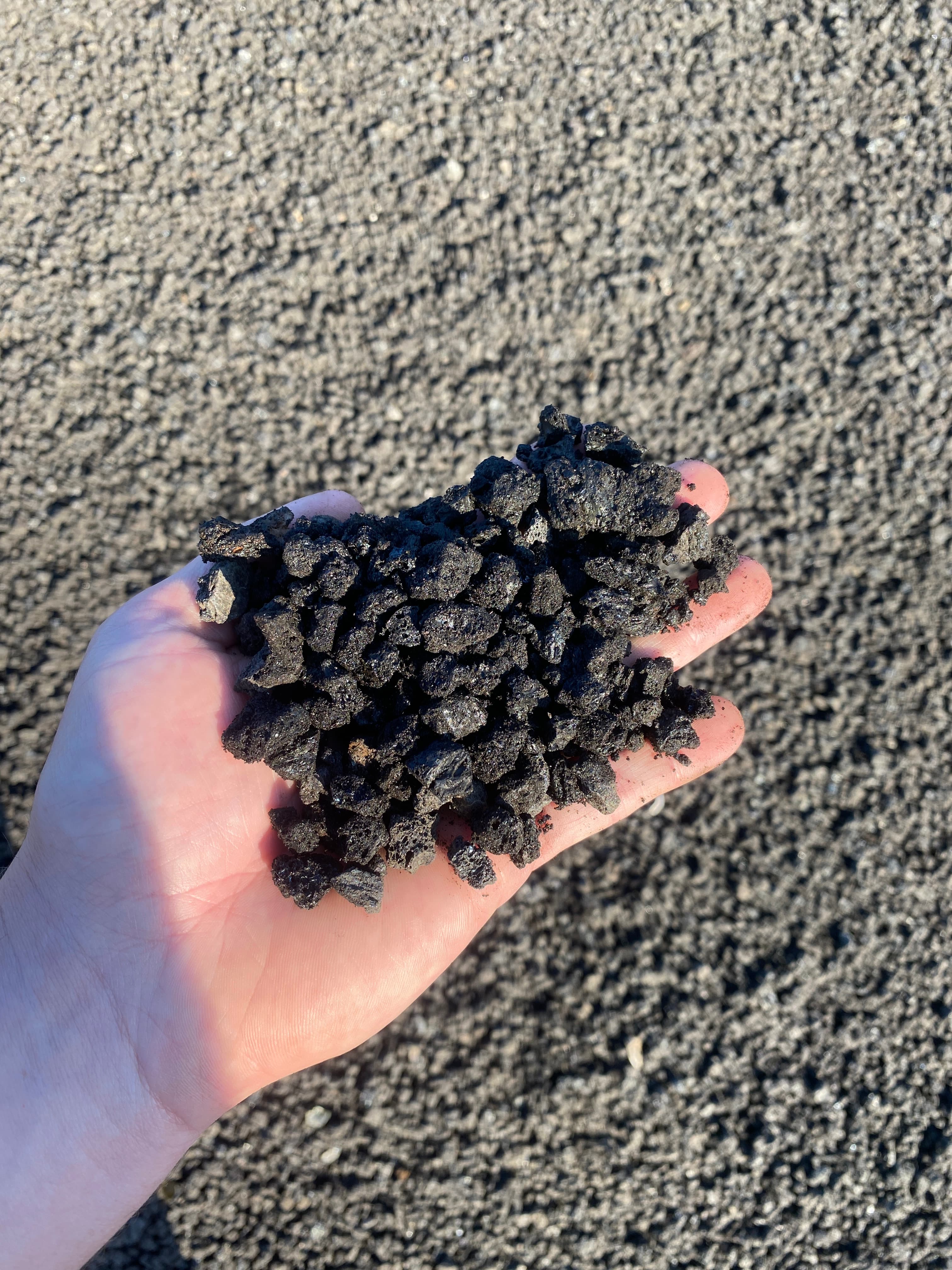
Black Lava Rock is the deepest black available here and the classic choice for contrast. It is also porous and noticeably light for its size, which makes it easier to move than any other rock on this page.
Striker Landscape Rock 2½ inch and Tuxedo Landscape Rock 2½ inch are the dark stone versions, in a much larger size. They read as a bold, deliberate landscape feature rather than as ground cover.
A Warmer Decorative Bed
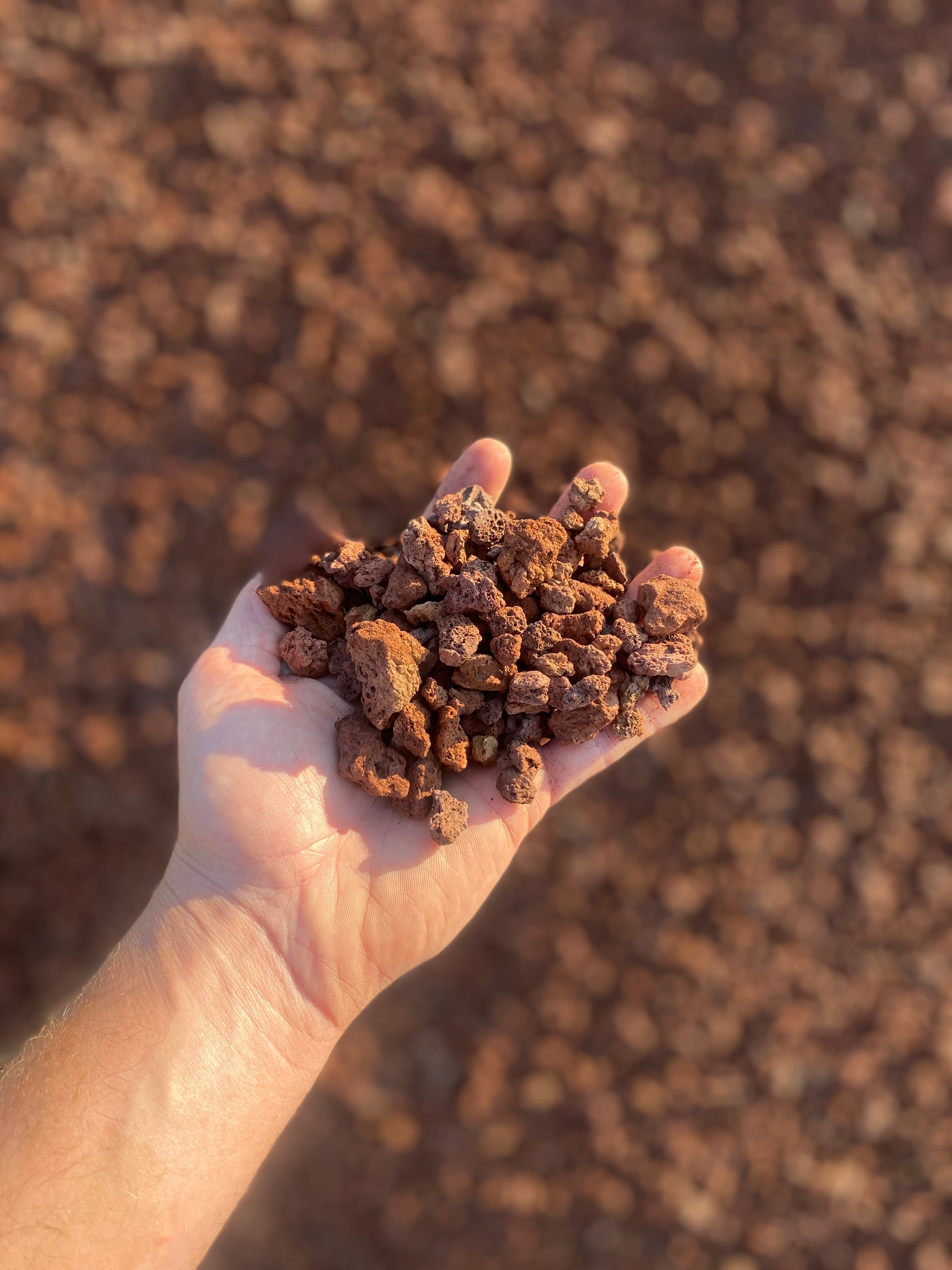
Red Lava Rock is the warm one. Rust-red, light to handle, and it holds its colour. It suits brick, warm siding, and planting schemes that would look cold against grey.
Like black lava it is porous, so a yard of it goes further per truckload than a yard of granite-weight stone.
A Light or Neutral Area
Limestone Landscape Rock 7/8 inch is the workhorse here. Light grey to near-white, small enough to look like a finished surface, and it brightens a north-facing bed where dark rock reads as a hole.
Limestone Landscape Rock 2½ inch is the same stone in a size that makes a statement, for bigger beds and around boulders.
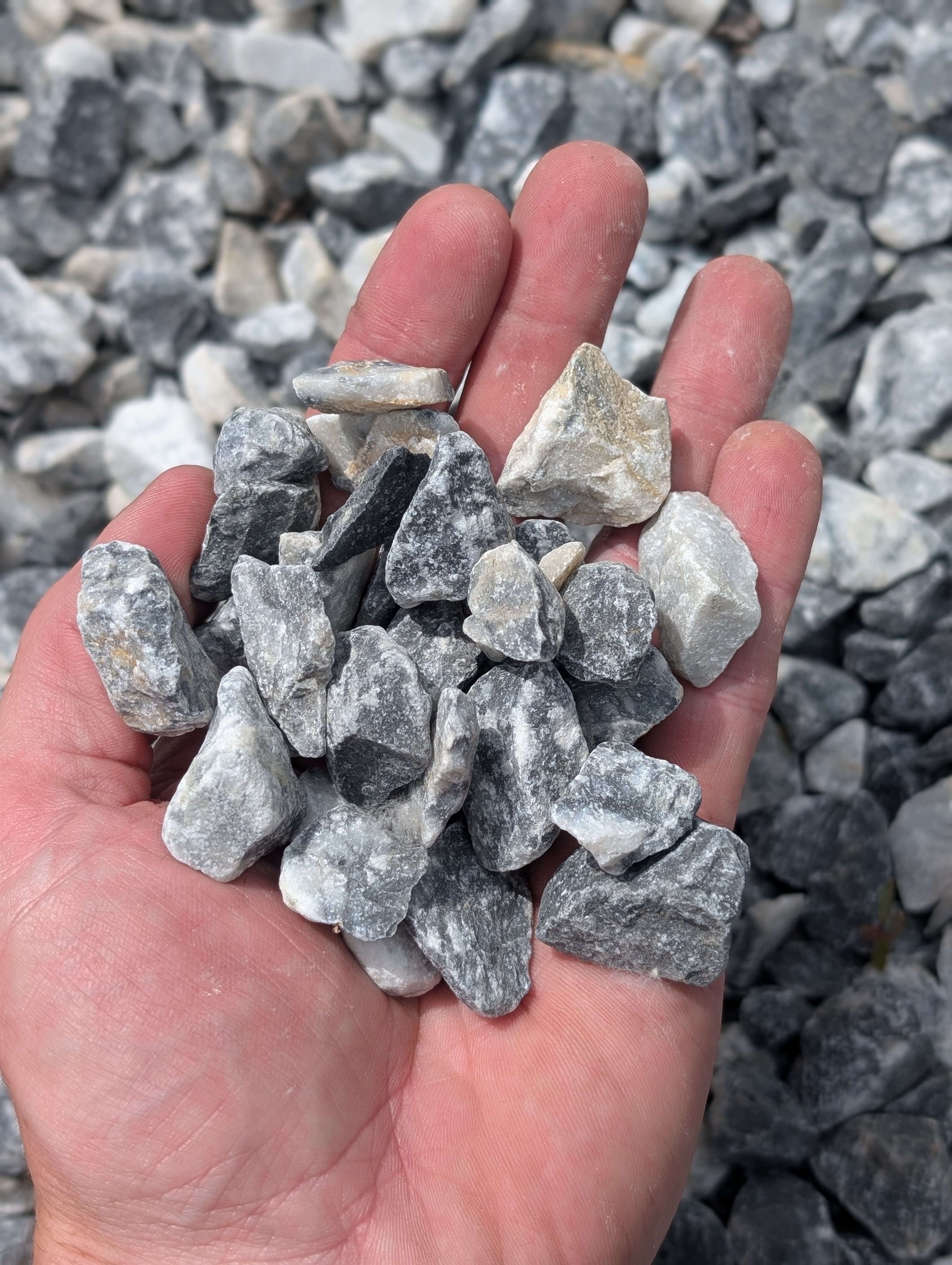
Blue Landscape Rock 3/4 inch sits between neutral and coloured: blue-grey with a subtle green tinge, angular, and it works against most houses without demanding attention. Green/Blue Landscape Rock 1½ inch is the bolder size of that colour family.
A Softer, Rounded Look
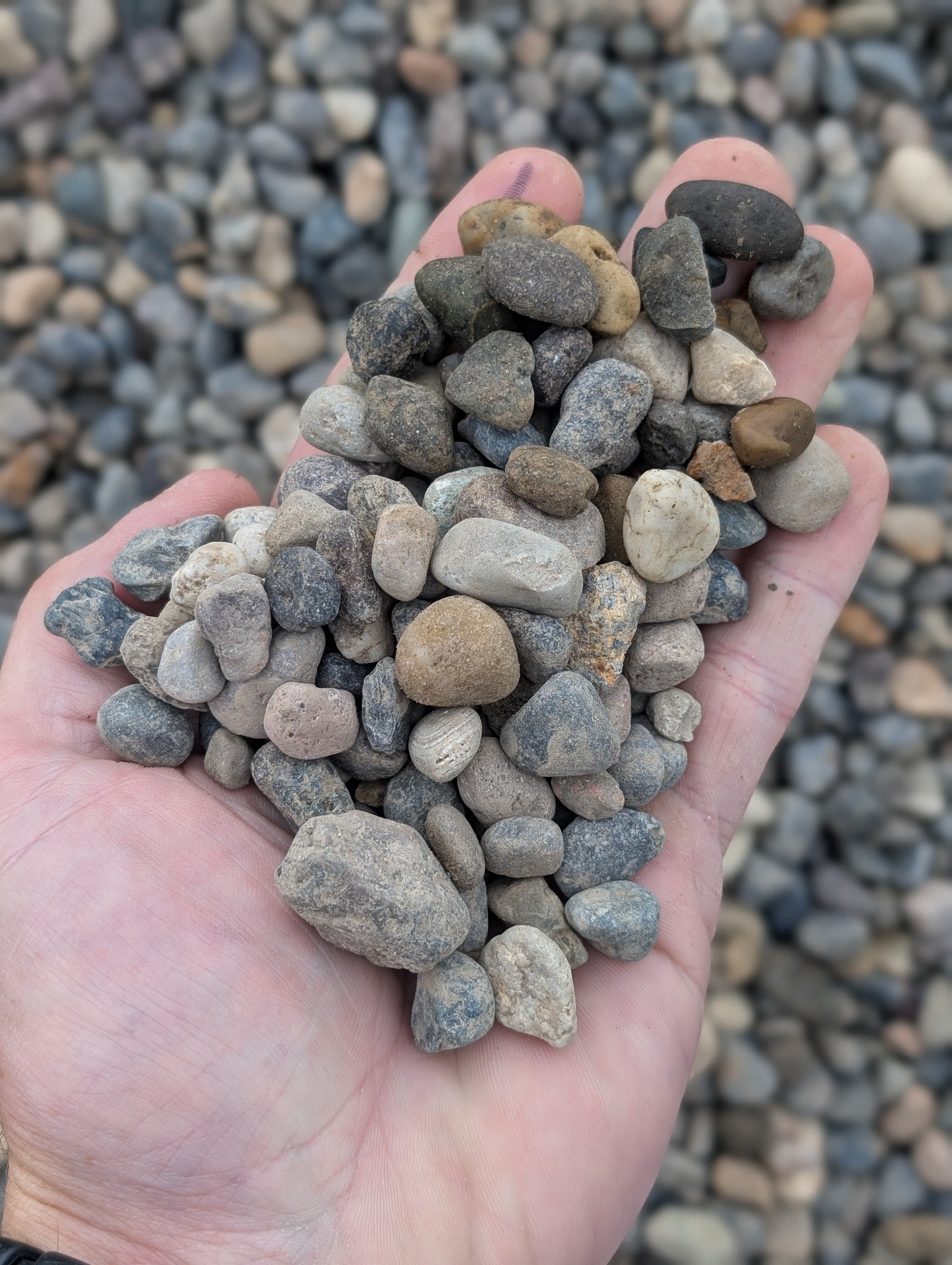
Pea Gravel 3/8 inch is washed and rounded, which is what makes it pleasant to look at and awkward to stand on. It moves under a foot, and anything with legs sinks into it over time.
If you want the size but not the movement, 5/16 inch fractured pea gravel is the angular version. The sharp faces lock against each other, which is also why it is the one to put down for winter traction.
A Drainage Area or a Dry Creek
Drain Rock 3/4 inch is the functional choice: clean washed stone with the fines removed, so water moves straight through it. It is what goes around perforated pipe and behind retaining walls, and it looks perfectly good doing it.
Washed Drain Rock 3/4 to 2 inch has more visual interest for a feature that people will look at.
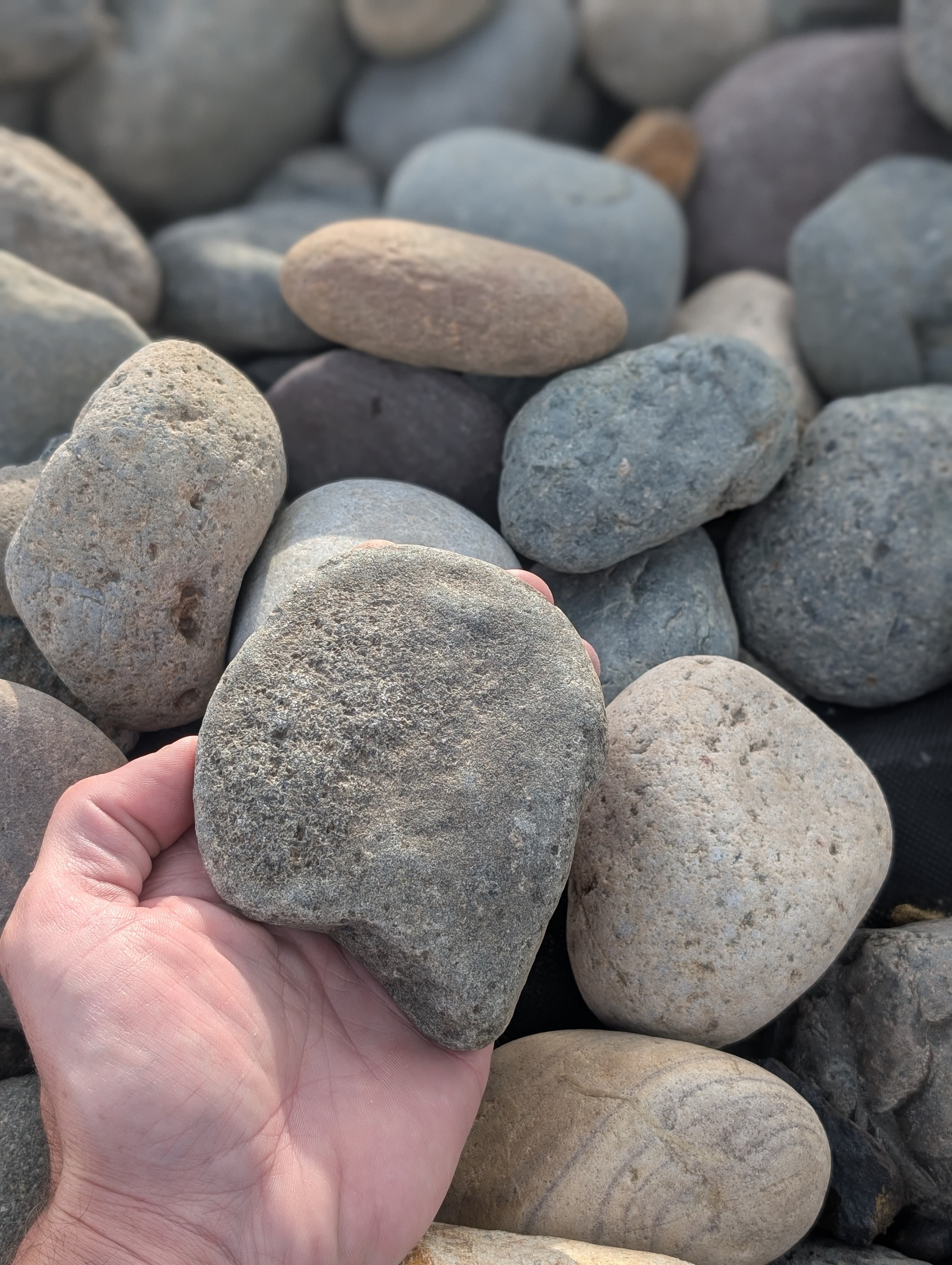
River Rock 3 to 6 inch is the dry creek material. Large, rounded, and laid deep enough to read as a creek bed rather than as scattered stones. It is also what you put where a downspout discharges, so the water lands on rock instead of digging a hole.
A Pathway
This is where people most often buy the wrong thing.
Loose decorative rock on a path looks good and walks badly. Every step displaces stone, it migrates out of the edges, and it is hard going with a wheelbarrow or a walker.
A compactable pathway material packs into a firm surface you can walk on properly. Limestone Driveway Gravel 1/2 inch minus is the tidiest of them, and Striker Driveway Gravel or Green/Blue Driveway both work if you want more colour.
If the path is decorative and rarely walked, loose rock is fine. If it is the way to the shed, use something that compacts. Limestone: driveway gravel vs landscape rock explains why the same stone behaves so differently in the two sizes.
A Large-Scale Statement
Striker Flats 4 to 6 inch is large flat blue-grey shale, hand-placed rather than spread, for accents and material transitions. The 2½ inch Striker, Tuxedo, and Limestone landscape rocks all work at property scale, where a smaller stone would just read as texture.
Big stone needs a deeper layer to hide the ground under it, so a bold bed costs more per square foot than it looks like it should.
The Strip Around the House
This one has a rule behind it rather than a preference. FireSmart guidance for the immediate zone, roughly the first 1.5 metres out from the walls, is non-combustible ground cover only. No bark, no chips, no rubber mulch.
Any of the rocks on this page do that job. Lava rock, 7/8 inch limestone, and drain rock are the usual choices because they are small enough to look tidy in a narrow strip. Why choose cedar mulch has the fuller explanation of what belongs where.
Side by Side
| Product | Colour | Size | Shape | Starting depth |
|---|---|---|---|---|
| Black Lava | Deep black | 3/8 to 3/4 in | Porous, angular | 3 in |
| Red Lava | Rust red | 3/8 to 1 in | Porous, angular | 3 in |
| Limestone 7/8 | Light grey to white | 7/8 in | Fractured | 3 in |
| Limestone 2½ | Light grey to white | 2½ in | Fractured | 3 to 4 in |
| Blue 3/4 | Blue-grey, green tinge | 3/4 in | Fractured | 3 in |
| Green/Blue 1½ | Blue-green | 1½ in | Fractured | 3 in |
| Striker 2½ | Dark blue-grey | 2½ in | Flat shale | 3 to 4 in |
| Tuxedo 2½ | Dark, mixed tone | 2½ in | Fractured | 3 to 4 in |
| Striker Flats | Dark blue-grey | 4 to 6 in | Large flat shale | Hand placed |
| Pea Gravel 3/8 | Natural mixed | 3/8 in | Rounded, washed | 2 to 3 in |
| Fractured Pea 5/16 | Natural mixed | 5/16 in | Angular, washed | 2 to 3 in |
| Drain Rock 3/4 | Natural grey | 3/4 in | Washed | 3 to 4 in |
| Drain Rock 3/4 to 2 | Natural grey | 3/4 to 2 in | Washed | 3 in |
| River Rock 3 to 6 | Natural mixed | 3 to 6 in | Rounded | 6 in |
Four things the table cannot show, and they matter:
None of these compact. Every product on this page is decorative or free-draining. If you need a surface to drive or wheel something on, you are in the driveway guide, not this one.
Comfort underfoot runs opposite to looks. Rounded stone is soft-looking and unstable. Larger stone is dramatic and awkward to walk on. Small fractured stone is the compromise, which is why 7/8 inch limestone ends up in so many yards.
Slopes need angular stone. Rounded rock migrates downhill, and it does it faster than you would think. Fractured stone locks, and a slope wants a border at the bottom regardless.
Weight limits your pickup, not volume. A cubic yard of most of this weighs about as much as a small motorcycle sitting in your box, and a half ton pickup is safely carrying roughly one yard. Lava rock is the exception, being porous and much lighter for its size. What fits in your vehicle has the real numbers.
Rock or Mulch?
A short fork rather than a second article.
Choose mulch when the bed is a planted, growing system: you want the soil improving as the mulch breaks down, you want moisture held through a dry July, and you do not mind topping it up. How much mulch do I need covers the amounts.
Choose rock when you want permanence, a non-wood surface near the house, contrast that does not fade, and no annual replenishment. Rock does not feed the soil, and that is the trade.
Plenty of yards use both: rock in the strip along the house and in the front feature beds, mulch everywhere plants are actually being grown.
Put Fabric Under It
Rock laid straight onto soil sinks into it, slowly and permanently. A ground cover fabric underneath keeps the stone where you put it and blocks most weeds from below. It is the cheapest part of the job and the part people skip.
It is not permanent weed control. Dust and leaf litter build up between stones over the years and things germinate in that, which is a rake-and-pull job rather than a fabric failure. Do you need landscape fabric under gravel, rock, or mulch covers which fabric and how to lay it.
Compare the Rock for Your Project
Measure the bed, pick a depth from the table, and the landscape rock calculator turns it into cubic yards. Every product page has its own photos, specs, and live price, and the estimator gives you the complete delivered total.
If you are choosing between two and cannot picture the difference, come and look at the piles. Colour at property scale is not something a photograph settles, and it is a five minute visit.
Bottom line: pick the colour and the size for the area, go 3 inches for small stone and deeper for big, angular on slopes, fabric underneath, and compactable material anywhere people actually walk.